Costa Rica
Costa Rica rewards pairing two regions in one trip: a coast stay and a jungle stay. Peninsula Papagayo, on the northern Pacific, is the country's luxury capital — home to the Four Seasons, Nekajui (Central America's first Ritz-Carlton Reserve), and the new Waldorf Astoria; Arenal brings volcano views and hot springs; the Osa Peninsula is the wildest place we've ever stayed; and Nosara leads for surf and wellness. Dry season runs mid-December through April while the green season brings afternoon rain, emerald landscapes, and the year's best rates.
Costa Rica invented the luxury eco-lodge, and it remains the place where wildness and comfort coexist better than anywhere else on the planet. Half a day's travel separates a swim-up suite on a Papagayo beach from a thatched bungalow where howler monkeys provide the wake-up call. The country's luxury scene has also just leveled up: two global flagships opened on the northern Pacific coast in 2025 alone, giving Costa Rica a resort corridor that now competes with anywhere in the tropics.
Where we cover in Costa Rica:
Peninsula Papagayo & Guanacaste — The gated, 1,400-acre peninsula on the northern Pacific coast is Costa Rica's luxury capital. Only twenty-five minutes from Liberia's international airport, it's the easiest true luxury landing in the country.
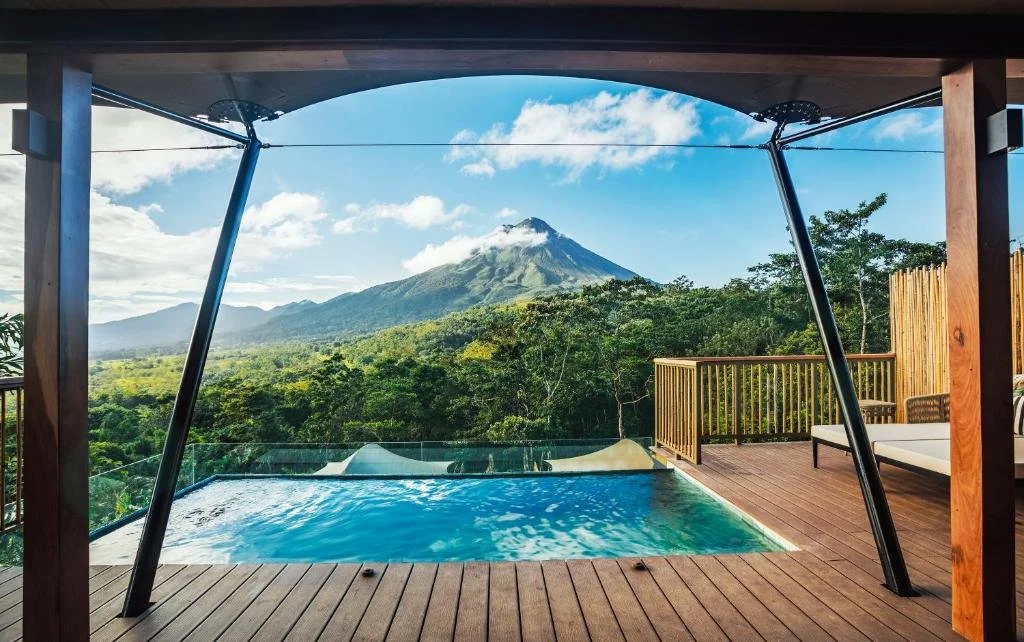
Arenal & La Fortuna — The postcard Costa Rica: a near-perfect volcano cone, rainforest canopy, waterfalls, and the country's famous hot springs. Nayara's three neighboring properties own the top tier here and Arenal's zip lines, hanging bridges, and hikes make it the natural jungle half of a first-timer's itinerary.
The Osa Peninsula — The wildest corner of the country, and the place that made us fall for Costa Rica. National Geographic has called Corcovado National Park one of the most biologically intense places on Earth, and staying at Lapa Rios remains one of the most memorable travel experiences we've had anywhere: scarlet macaws over the deck, monkeys in all four Costa Rican varieties, and a rainforest that comes right to the shower. Reaching it takes a small plane and a rough road; that's the filter, and the reward.
Nosara — The Pacific surf-and-wellness town that grew up without losing itself: no high-rises, protected beachfront, world-class longboard waves at Playa Guiones, and a yoga scene that predates the trend by decades. Nosara is the right base for travelers who want their Costa Rica active, barefoot, and routine-friendly with surf mornings, smoothie bowls, and sunset as the evening's entertainment. Read our best hotels in Nosara here.
Manuel Antonio & the Central Pacific — Costa Rica's most accessible wildlife: a compact national park where sloths, capuchins, and toucans practically pose beside the trails, ringed by beaches and a hillside hotel scene. It's the easiest add for families driving from San José, and the classic first taste of the country's jungle-meets-beach formula.
The Southern Mountains — Inland and upland, coffee country climbs into cloud forest and Hacienda AltaGracia, the wellness estate above San Isidro, has become the country's great restorative escape: a working hacienda with horses, a river-fed spa, and mornings above the clouds. For travelers whose Costa Rica is about coming back to themselves rather than checking off wildlife, this is the region.
Best time to visit Costa Rica: Mid-December through April is the dry season with reliable sun, peak rates, and the whole country open for business, with Guanacaste and Papagayo the driest of all. The green season, May through November, brings afternoon showers, fuller rivers and waterfalls, luminous landscapes, and meaningfully softer rates at the top resorts; September and October are the wettest months on the Pacific side, and the shoulder months of May, June, and November are the sweet spot for value. Whale season peaks on the southern Pacific coast from roughly August through October.