
Best Hotels on the Amalfi Coast (2026): A Luxury Guide to Where to Stay
There are stretches of Italian coastline that live up to their reputation and stretches that don't. The Amalfi Coast lives up to it — and then some. Fifty kilometers of cliff-hung villages, turquoise water, terraced lemon groves, and the kind of light that makes everything look like a painting are exactly what the photographs promise. What the photographs don't convey is how logistically complicated it all is, how crowded the most famous towns get in high summer, and how dramatically the quality of your experience rises or falls depending on where you choose to sleep.
We put this guide together to make that decision easier. It covers the properties we'd actually book across every town on the coast — from the iconic grand dames of Positano and Ravello to the quieter, more residential bases that experienced Amalfi travelers tend to prefer on return trips. Whether you're planning a romantic escape, a honeymoon, or a longer Italian itinerary that includes a few days on the coast, this is the honest edit of where the money is well spent.
If you're building a wider Italy trip around the coast, our guides to the best hotels in Puglia, Hotel Il Pellicano in Tuscany, and the best hotels on Lake Maggiore cover the rest of the country's most compelling coastal and countryside stays.
Quick Reference: Best Hotels on the Amalfi Coast
Hotel Town Best For Rates From
Le Sirenuse Positano Honeymoons, romance ~$1,400/night
Il San Pietro Positano Privacy, beach club ~$1,800/night
Monastero Santa Rosa Conca dei Marini Design, serenity ~$1,200/night
Belmond Hotel Caruso Ravello Infinity pool, views ~$1,500/night
Palazzo Avino Ravello Glamour, beach club ~$900/night
Hotel Villa Cimbrone Ravello Gardens/history ~$600/night
Hotel Santa Caterina Amalfi Cliffside pool, families ~$700/night
Luna Convento Amalfi History, value ~$400/night
Borgo Santandrea Amalfi Design-forward ~$900/night
Where to Stay on the Amalfi Coast: A Quick Orientation
Before diving into the hotels, it helps to understand what you're choosing between — because on the Amalfi Coast, location is everything.
Positano is the most photographed town and the most romantic. It's stacked vertically above a small beach, with bougainvillea-draped alleyways, designer boutiques, and the kind of beauty that makes grown adults stop mid-sentence. It's also the most crowded town on the coast, and getting around — up and down stairs and steep lanes — is genuinely exhausting in July and August heat.
Ravello sits high above the coast road, roughly 300 meters above sea level, which gives it an entirely different energy. It's quiet, elegant, and serious — the kind of place where you read for a week and feel completely restored. The tradeoff is that sea access requires a shuttle or drive down to Minori or a beach club arrangement through your hotel.
Amalfi town is the most strategic base. It sits at the geographic midpoint of the coast, has ferry connections in both directions, and is flat enough to navigate without an hour of stair-climbing. It's the right call for travelers who want to explore multiple towns and not spend their trip waiting for taxis.
Praiano is the quiet alternative: a small fishing village between Positano and Amalfi that's sunset-facing, noticeably less crowded, and home to some very good value hotels. It's where repeat visitors often end up, having discovered that the Amalfi Coast is more enjoyable at one remove from its most famous spots.
The Best Hotels in Positano
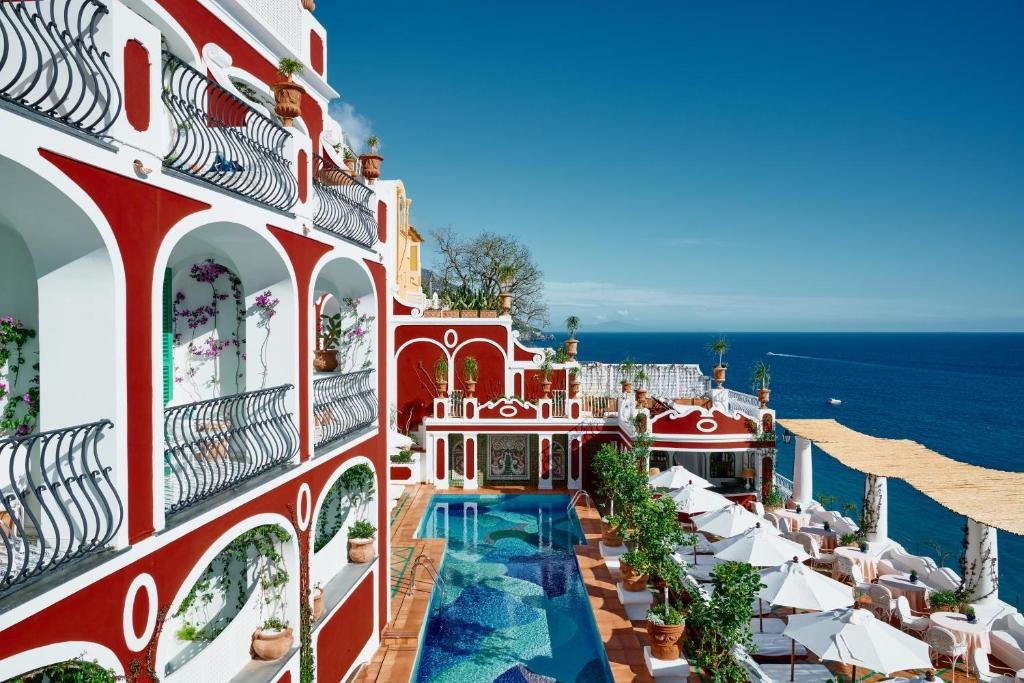
Le Sirenuse — The Definitive Positano Hotel
If you ask anyone who has spent serious time on the Amalfi Coast which hotel best embodies Positano, the answer is almost always Le Sirenuse. It has been operating since 1951, when the Marchesi Sersale family opened their private villa to guests — and the family still owns and runs it today. That continuity is evident in every detail: the hand-painted Vietri tiles on the floors, the antique furniture gathered over decades, the staff who know returning guests by name, and the sense that this is a house someone genuinely loves rather than a hotel managed by committee.
The 58 rooms and suites are each individually furnished, all with sea views, and all with the kind of carefully calibrated comfort that takes decades to get right. The pool terrace — small, tiled in classic Mediterranean colors, looking straight out over the rooftops of Positano and down to the sea — is one of the great hotel pools in Europe. The restaurant, Franco's Bar, is the best people-watching in Positano. And the access to a vintage wooden boat for daily excursions to hidden grottos and coves is the kind of added element that transforms a beautiful hotel stay into something genuinely memorable.
Book far in advance — Le Sirenuse sells out a year ahead for peak summer dates, and peak-season rooms at the top end reach €3,000+ per night. For the Amalfi Coast experience at its most iconic, it earns every euro.
Best for: Honeymoons, special occasions, first-timers who want the definitive Positano experience. Rates from approximately $1,400/night in shoulder season.
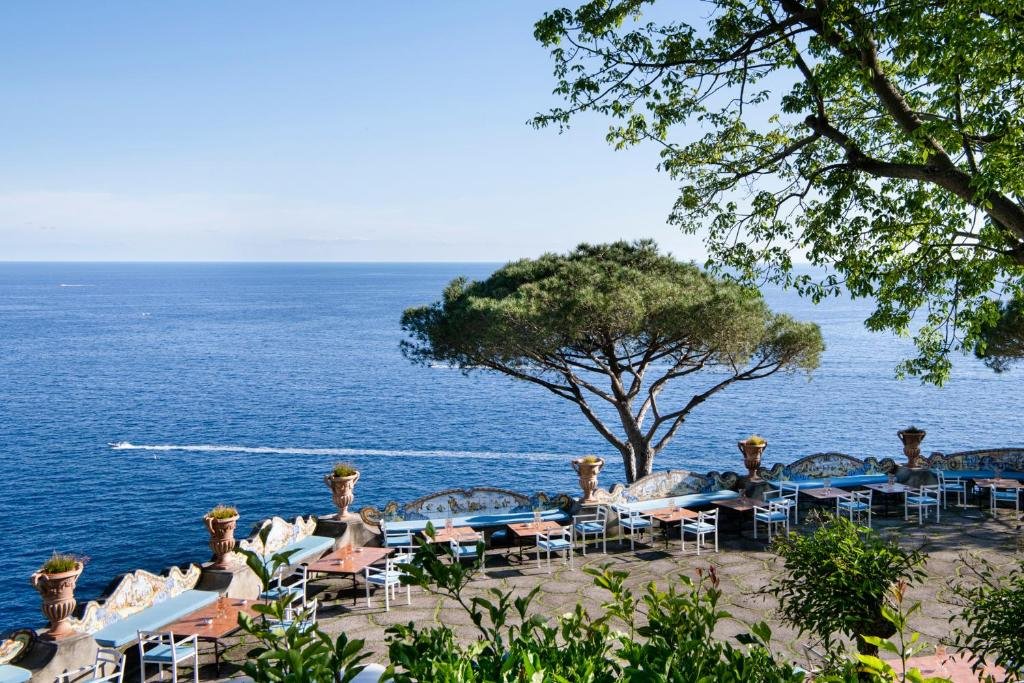
Il San Pietro di Positano — Ultimate Seclusion on the Cliff
A kilometer outside Positano's center, carved directly into the cliff face with an elevator cut through the rock to reach the private beach below, Il San Pietro di Positano operates at a level of seclusion that's rare anywhere on the Italian coast. This is the hotel for travelers who want maximum privacy, resort-level amenities in a genuinely intimate setting (just 60 rooms and suites), and beach access that bypasses the organized chaos of Positano's main sands entirely.
The rooms are among the most beautifully appointed on the coast — each one different, each one opening onto a private terrace with views that stretch from the Faraglioni rocks of Capri to the Positano bay. The beach club at the bottom of the cliff elevator has its own restaurant, sunbathing platforms directly over the water, and a seaside tennis court that might be the most dramatically positioned in the world. Upstairs, the Michelin-starred restaurant Zass sources from the hotel's own gardens and delivers some of the finest cooking on the coast.
If Le Sirenuse is Positano at its most social, Il San Pietro is Positano at its most private. For couples who want to disappear for a week, it's as close to perfect as the coast gets.
Best for: Couples, honeymooners, travelers prioritizing privacy and direct sea access. Rates from approximately $1,800/night in peak season.
The Best Hotels in Ravello
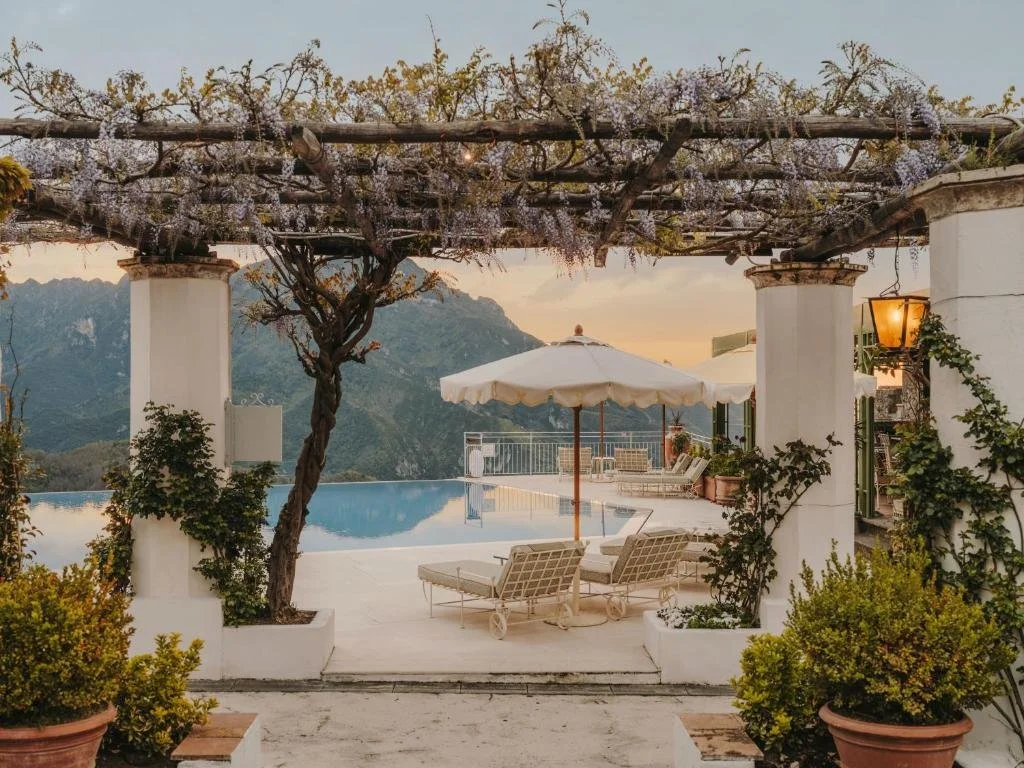
Belmond Hotel Caruso — The Infinity Pool That Lives Up to the Photograph
Ravello's most famous image — a cantilevered infinity pool appearing to pour directly off the cliff into the sea far below — belongs to Belmond Hotel Caruso, and the photograph tells the truth. The pool is extraordinary. The panorama stretching from the pool terrace, past the terraced gardens, all the way to the coastline and the open Mediterranean, is the kind of view you genuinely stop talking and just look at.
Caruso is built into an eleventh-century palazzo, and the interiors hold the history carefully — frescoed ceilings, antique floors, the feeling of a private villa that has belonged to someone extraordinary for a very long time. The 50 rooms and suites are large by Amalfi Coast standards, service is polished without being stiff, and the hotel's position at the quiet end of Ravello means the only competition for your sun lounger is the occasional hummingbird in the bougainvillea.
For travelers who want the most elevated version of an Amalfi Coast stay — literally and aesthetically — and who don't need direct sea access to be happy, Caruso is a strong case for Ravello over Positano.
Best for: Couples celebrating special occasions, guests who prioritize views and service over beach access. Rates from approximately $1,500/night in peak season.
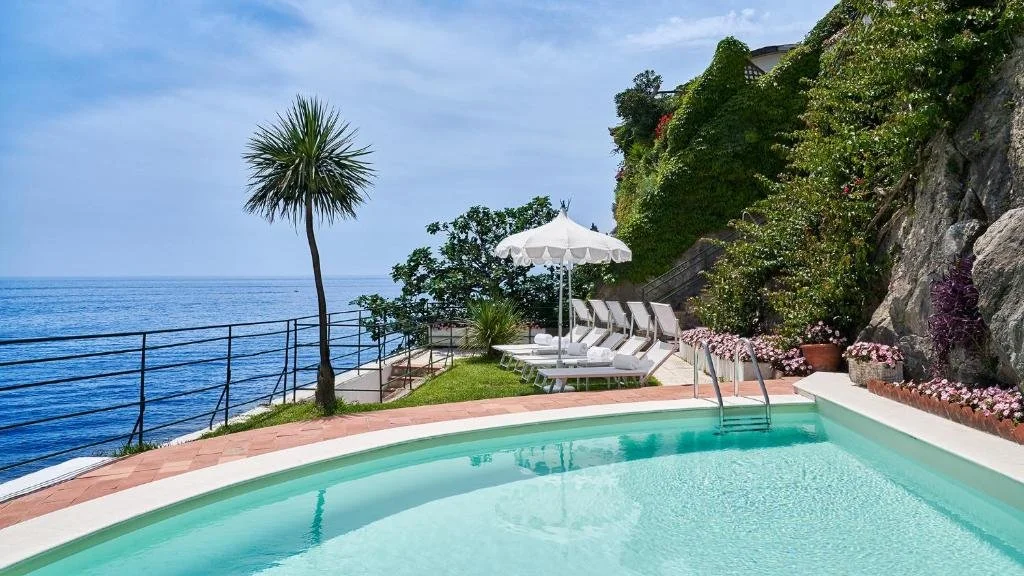
Palazzo Avino — Hillside Glamour with Beach Club Access
Palazzo Avino is the glamorous choice in Ravello — a twelfth-century pink villa perched above the town, with a Michelin-starred restaurant, a rooftop pool with sweeping views, and a dedicated beach club at Minori accessible by shuttle. The interior design is more overtly luxurious than Caruso's restrained classicism: bold fabrics, handcrafted majolica, the kind of confident color and pattern that reads as Italian maximalism at its most appealing.
The 43 rooms and suites are beautiful and deeply comfortable. The Rossellinis restaurant has held its Michelin star since 2007. And the beach club arrangement — a private shuttle that runs multiple times daily to a beach club with loungers, food, and sea access — solves the one genuine inconvenience of staying in Ravello without sacrificing the altitude and views that make the town worth visiting.
For a Ravello stay that doesn't feel like a retreat from the world — that has genuine energy, a social scene, and something to do in the evenings — Palazzo Avino is the right choice over the quieter, more contemplative Caruso.
Best for: Travelers who want Ravello's elevation and views but also want beach access and a lively atmosphere. Rates from approximately $900/night in shoulder season.
Hotel Villa Cimbrone — Historic Gardens and the Most Famous View in Italy
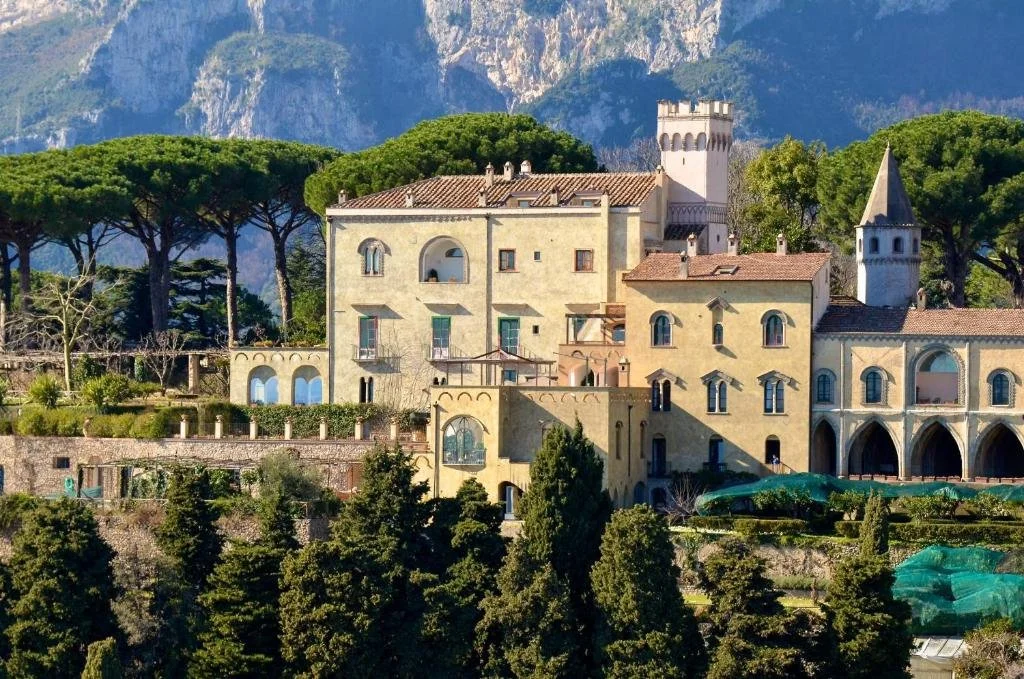
Hotel Villa Cimbrone is the historical choice in Ravello — a medieval villa transformed into a hotel, set within one of the most celebrated gardens in Italy, with the Terrazza dell'Infinito at the far end offering a panorama that has been described by visitors from Virginia Woolf to Gore Vidal as among the finest views in the world. The terrace is technically public during the day, which brings visitors through the garden — but by late afternoon, when the day-trippers have returned to the coast road and the hotel guests have the property to themselves, Villa Cimbrone becomes extraordinary.
The 19 rooms and suites are individually decorated, each with its own character, all with frescoed ceilings or antique stone floors. The hotel has no pool and beach access requires the same shuttle arrangement as Palazzo Avino. What it does offer — historical atmosphere, extraordinary gardens, and the most distinctive setting of any hotel in Ravello — is genuinely unmatched.
Best for: Design-focused travelers, history enthusiasts, guests who want Ravello's most literary and atmospheric stay. Rates from approximately $600/night in shoulder season.
The Best Hotels in Amalfi Town
Hotel Santa Caterina — The Grand Dame of Amalfi
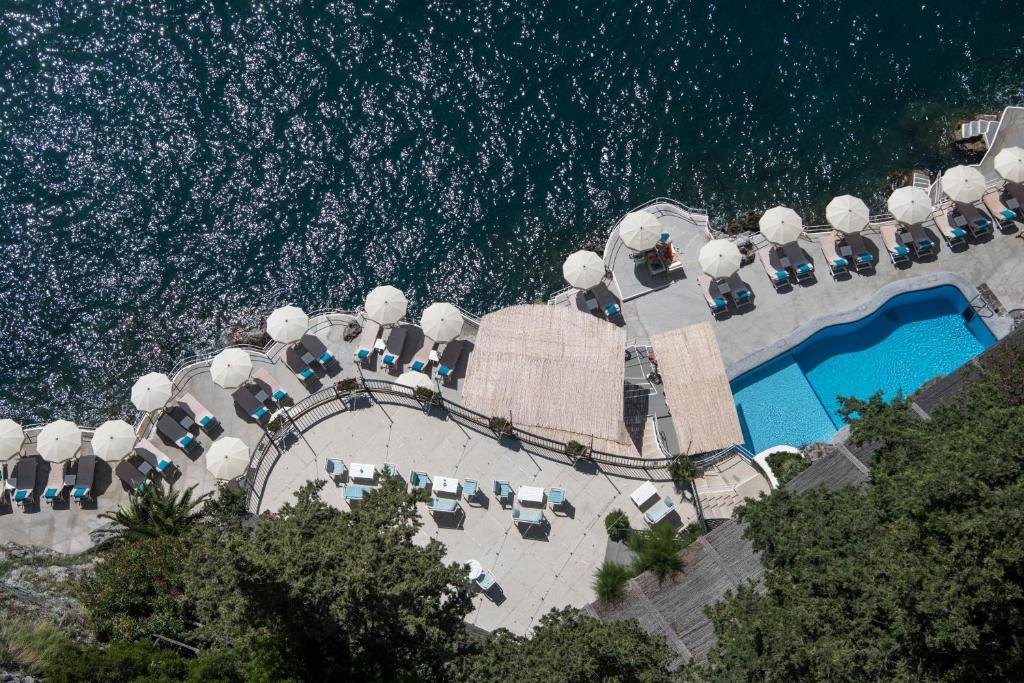
Hotel Santa Caterina has been operating since 1880 and has earned its reputation as the finest hotel in Amalfi town with a combination of extraordinary positioning, consistent service, and the kind of incremental refinement that only comes from more than a century of ownership by the same family. The hotel steps down a cliff above a private cove, connected by elevators carved into the rock to a saltwater pool, a sun terrace, and a beach club directly at the water's edge — one of the only hotels on this part of the coast with genuine private sea access.
The 66 rooms and suites are large by Amalfi standards, beautifully decorated with handmade Vietri majolica tiles, and most have sea-view balconies or terraces. The Michelin-starred restaurant and the more casual Glicine restaurant are both excellent — the casual lunch by the pool particularly so. And the location in Amalfi town means ferry connections and town life are a 10-minute walk away, making this the most practically convenient of the luxury options on the coast.
For families or groups who want a luxury hotel without the logistical complications of Positano or the altitude trade-off of Ravello, Santa Caterina is the straightforward best choice.
Best for: Couples, families, guests who want luxury with central access and genuine sea reach. Rates from approximately $700/night in shoulder season.
Borgo Santandrea — The Most Dramatic New Arrival
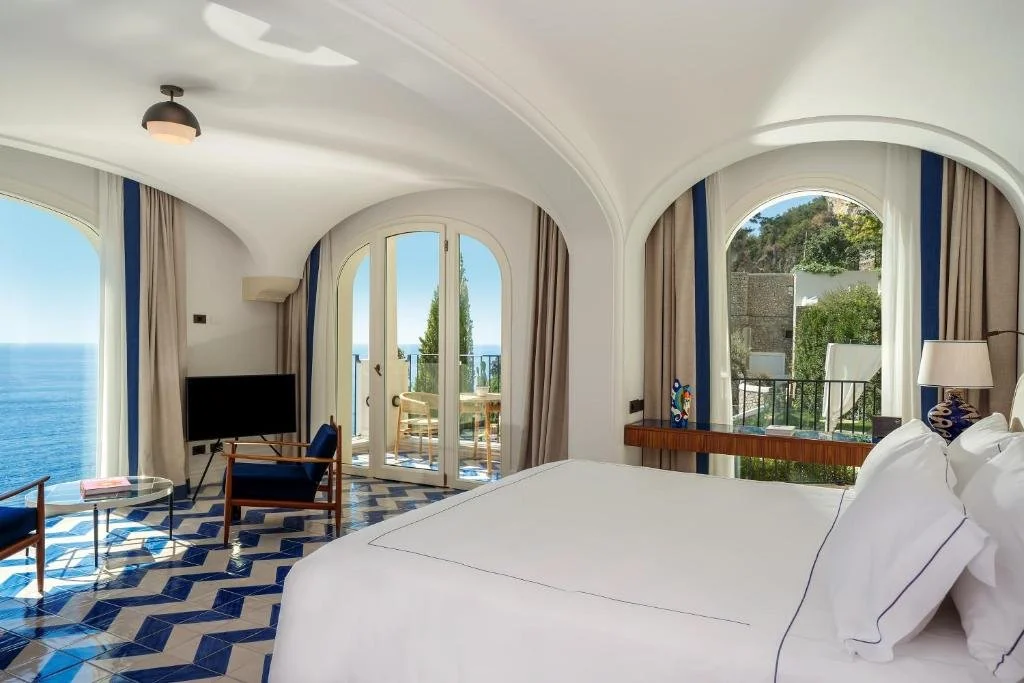
Borgo Santandrea opened relatively recently and has quickly established itself as one of the most architecturally arresting hotels on the coast — a series of terraced suites and villas carved into the cliff between Amalfi town and Conca dei Marini, with pools suspended above the sea, spa facilities set into natural grottos, and a visual drama that is frankly difficult to exaggerate. This is the hotel that photographs the most extraordinarily on social media, and unlike many hotels that photograph well, it actually lives up to the pictures in person.
The design is contemporary without being cold — warm stone, natural materials, a palette that takes its cues from the cliff and the sea rather than imposing something foreign on them. The suites are genuinely beautiful, most with private pools or plunge pools, all with the kind of views that make you wonder why you would ever need to leave.
Best for: Design-obsessed travelers, couples who want the most visually extraordinary stay on the coast. Rates from approximately $900/night in peak season.
Luna Convento — History and Value in the Heart of Amalfi
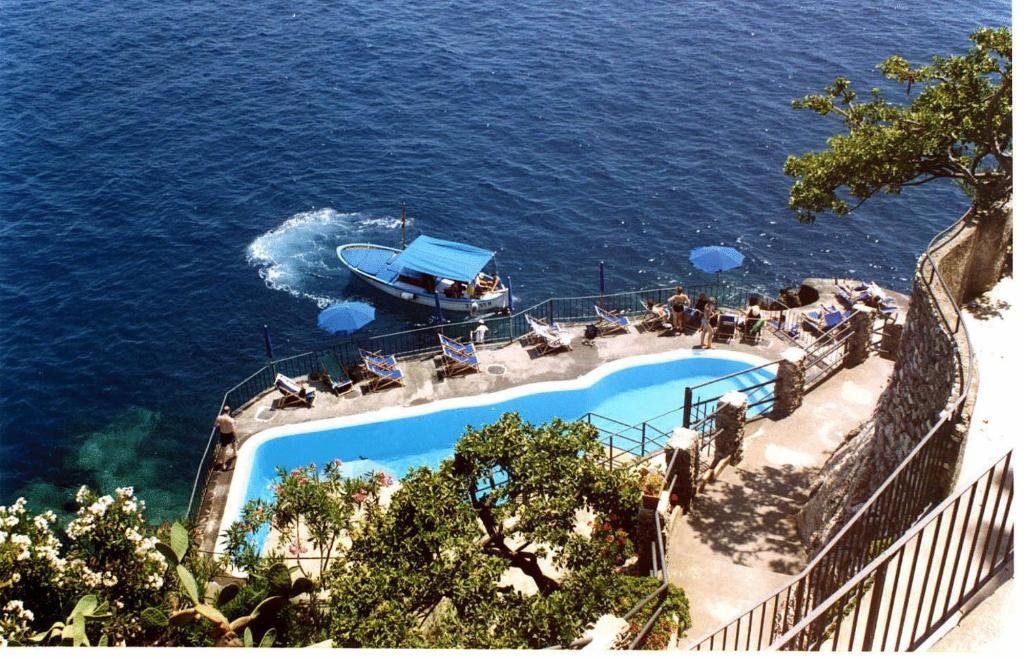
Founded as a Franciscan monastery in 1222 — St. Francis of Assisi reputedly stayed here — Luna Convento is the oldest hotel on the Amalfi Coast and one of the most atmospheric in southern Italy. The Byzantine cloister at its center, the medieval tower above the coast road (now home to one of the hotel's two restaurants), the Byzantine chapel, and the pool carved directly into the coastal rock all give the property a sense of layered history that no amount of renovation can manufacture.
The rooms are comfortable rather than extravagant, and rates are meaningfully lower than the Amalfi Coast grand hotels — making this the right choice for travelers who want history and atmosphere over design-forward luxury. The sea access through the lower pool terrace is genuine, the ferry pier is a short walk, and Amalfi's historic center is minutes away on foot.
Best for: History enthusiasts, travelers looking for value at the Amalfi luxury tier, guests who want monastic atmosphere over contemporary luxury. Rates from approximately $400/night in peak season.
The Best Hotel in Conca dei Marini
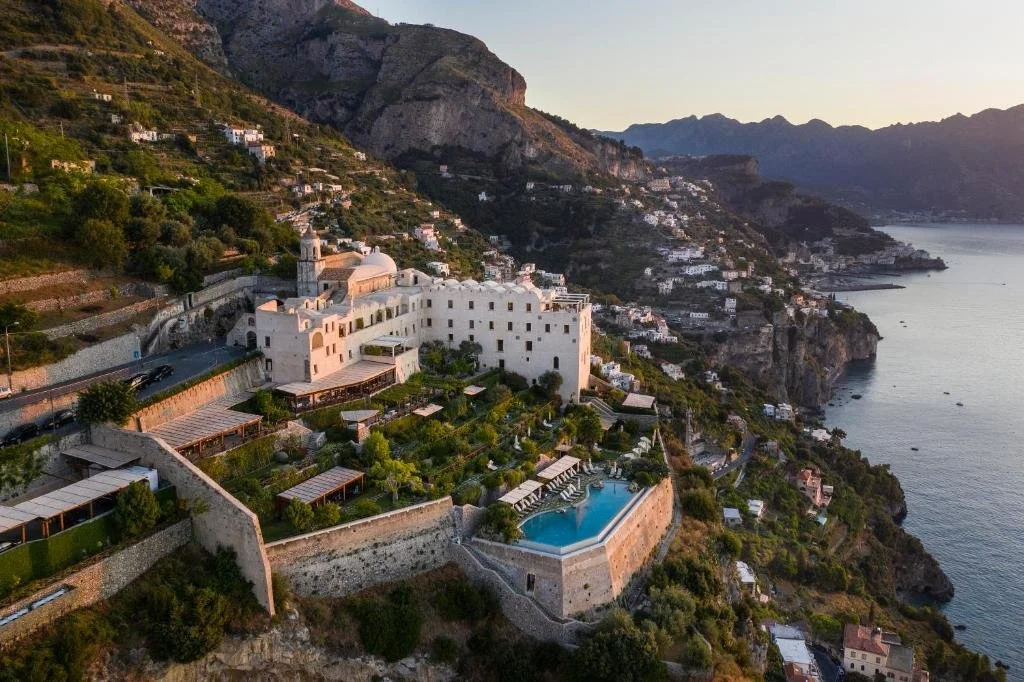
Monastero Santa Rosa — The Most Serene Hotel on the Coast
Monastero Santa Rosa sits in Conca dei Marini — a tiny village between Amalfi and Positano that most visitors pass through without stopping — in a seventeenth-century Dominican monastery that has been transformed into one of the most quiet and precisely beautiful boutique hotels on the Italian coast. There are only 20 rooms and suites, all with sea views, set across terraced gardens full of lemon trees and bougainvillea that cascade down to a cliff-edge pool with an unobstructed view of the Tyrrhenian Sea.
The hotel's aesthetic is monastic in the most appealing sense — stripped back, honest materials, extraordinary light, no visual noise. The restaurant is exceptional. The spa is genuinely one of the best on the coast. And the absence of a beach (guests use the pool and sun terraces above the cliff) is barely felt given how completely the property succeeds on its own terms.
For a wellness-focused or anniversary stay where serenity is the entire point, Monastero Santa Rosa is our strongest recommendation on the coast.
Best for: Couples seeking quiet restoration, wellness travelers, guests celebrating anniversaries or honeymoons who want maximum serenity. Rates from approximately $1,200/night in peak season.
When to Go: Best Time to Visit the Amalfi Coast
The Amalfi Coast is seasonal in a way that makes timing consequential. Here is the honest breakdown.
May and early June are the best months: warm enough to swim, the lemon orchards in full fragrance, the towns alive but not yet overwhelmed by high-season crowds, and hotel rates at meaningful shoulder-season levels below peak. Late September and October offer the same advantages after the summer rush subsides, with the added benefit of warmer sea temperatures from months of summer sun.
July and August are spectacular but crowded — especially in Positano, where the main beach and the narrow lanes leading to it become genuinely oppressive by midday. If you must visit in peak season, stay in Ravello or Praiano and day-trip to Positano by ferry, arriving early and leaving before noon. The difference between 8am and 11am in Positano in August is the difference between a beautiful place and a beautiful place you can't actually move through.
April is increasingly popular with travelers who want the mild weather, the empty terraces, and the lemon trees just coming into blossom — but water temperatures are still cool for swimming, and some smaller restaurants and beach clubs haven't yet opened for the season.
The coast is generally closed from November through March, with some exceptions in the larger towns. Most of the hotels in this guide operate from approximately April to late October.
How to Get Around the Amalfi Coast
Getting around the Amalfi Coast requires a strategy, and the right one depends on where you're staying and what you're trying to do.
The ferry is the answer for most inter-town movement from April through October. Travelmar and NLG run regular services connecting Salerno, Maiori, Minori, Amalfi, Positano, and Capri. Ferries are faster than the coast road in summer, more scenic, and don't get stuck in the traffic that makes the SS163 genuinely miserable between about 10am and 5pm in July and August. Buy tickets at the pier — do not buy on board.
The SITA bus is cheap and serves every town including Ravello, but in peak season the waits at major stops can be considerable and the buses themselves are sardine-dense. For one or two rides it's fine; as a primary transport strategy in summer it will frustrate you.
A private driver is the luxury option and, for a group, often not dramatically more expensive than coordinating taxis. For arrivals from Naples airport, transfers from Rome, or a full-day excursion to Capri or Pompeii, a private driver significantly reduces stress. Ask your hotel to arrange one on arrival.
Do not rent a car for a stay based in Amalfi or Positano. Parking is either unavailable or extortionately expensive, the coast road is a single-lane nightmare in summer, and most of the places you want to go are more easily reached by boat.
Day Trips from the Amalfi Coast Worth Planning Around
The Amalfi Coast's greatest logistical advantage is what's within reach. Capri is a ferry from Positano or Amalfi — an hour each way, and a day on the island (the Blue Grotto, the Faraglioni rocks seen from the water, lunch at Da Paolino under lemon trees) is one of the best day trips in Italy. Book the return ferry early in the day; the last boats fill fast.
Pompeii is an hour from Amalfi by road or a ferry-and-train combination via Salerno. The site opens early and rewards an early start — by 10am in summer it's already warm and crowded. A morning at Pompeii followed by lunch back on the coast is a very good day. Herculaneum, smaller and better-preserved than Pompeii, is 90 minutes away and worth considering if Pompeii feels overwhelming.
Ravello's gardens — Villa Rufolo and Villa Cimbrone — are open to day visitors regardless of whether you're staying there, and the drive or bus up from Amalfi takes about 20 minutes. If your base is in Positano or Amalfi, an afternoon in Ravello with dinner is entirely manageable.
Frequently Asked Questions About Hotels on the Amalfi Coast
What is the best hotel on the Amalfi Coast? Le Sirenuse in Positano is the most iconic and consistently exceptional hotel on the coast — family-owned since 1951, with 58 individually furnished rooms, one of the great pool terraces in Europe, and the best people-watching on the Italian coastline. For maximum seclusion, Il San Pietro di Positano rivals it. For views above the sea, Belmond Hotel Caruso in Ravello is the strongest alternative.
What is the most luxurious hotel on the Amalfi Coast? Il San Pietro di Positano and Le Sirenuse are the two properties that consistently top luxury rankings for the coast. Monastero Santa Rosa in Conca dei Marini and Belmond Hotel Caruso in Ravello are close behind. All four operate at a level that competes with the finest hotels anywhere in the Mediterranean.
Where should I stay on the Amalfi Coast for the first time? Positano for romance and first impressions; Amalfi town for practical day-trip access to the full coast; Ravello if you want quiet and extraordinary views. For a first visit with a partner or spouse, Positano at Le Sirenuse or a hotel in Amalfi at Santa Caterina are the two most straightforward excellent choices.
Is the Amalfi Coast better than Puglia? They offer genuinely different experiences. The Amalfi Coast is more dramatic, more iconic, and more expensive — the cliff-hung villages, the turquoise water, the sense of a landscape that looks exactly as advertised. Puglia is warmer in character, more distinctive in its accommodation (the masserias are unlike anything on the Amalfi Coast), and significantly better value. For families specifically, Puglia is often the better choice. For romance and the definitive Italian coast experience, the Amalfi Coast wins.
When is the best time to visit the Amalfi Coast? Late May through early June, and September through mid-October. The shoulder seasons deliver warm weather, swimmable water, and meaningfully smaller crowds. July and August are beautiful but crowded — plan around early mornings and ferry travel if you visit then.
How long should I spend on the Amalfi Coast? Three to four nights is the minimum for a proper experience — enough time to settle into your hotel, explore two or three towns, take a day trip to Capri, and eat well without rushing. Five to seven nights works if the coast is the focus of your Italy trip. Anything under three nights will feel rushed given the time lost to traveling the coast road.
Can you do the Amalfi Coast with kids? Yes, with the right hotel and base. Amalfi town is the most family-friendly base — flatter than Positano, with beach access, ferry connections, and a wide piazza where children can move freely. Hotel Santa Caterina accommodates families well. The staircases and vertical terrain of Positano are harder to navigate with small children and strollers. For a multi-generational Italy trip with young children, consider adding a few nights in Puglia at Borgo Egnazia before or after the coast.
Is the Amalfi Coast worth it? Without qualification: yes. The combination of extraordinary natural scenery, exceptional food, beautiful hotels, and a concentration of experiences within a small geographic area make it one of the finest coastal destinations in the world. Go in shoulder season, choose your base carefully, and book the best hotel you can afford — the upgrade from a decent hotel to a great one on the Amalfi Coast is more noticeable than almost anywhere else we've traveled.