
The 10 Dreamiest Hotels in Morocco (2026)
Royal Mansour is the most extravagant hotel in Morocco and possibly in Africa, built by the king, with individual three-storey riads and staff who move through tunnels beneath you so you never see them arrive. La Mamounia is the icon, ninety years old and set in twenty acres of garden. But the dreamiest thing in the country is Dar Ahlam, a kasbah in a palm grove where there are no menus, no schedule, and dinner appears somewhere different every night. Morocco also happens to be the best-value luxury destination we cover, where a room that would cost €2,000 in Europe costs €600 here. Nothing on this page is sponsored.
Morocco does something no other country we cover quite manages. You can spend a night in a palace, a night in a courtyard house down an alley too narrow for a car, and a night in a tent on a dune, all within one week and all at a standard that would cost three times as much in Europe.
That variety is the reason to go and also the thing that makes planning confusing. So before the list, the four kinds of place you can stay.
Riads are traditional courtyard houses inside the medina walls. They look inward, so there are no views out, and the whole building is arranged around a central court, usually with a small pool or fountain. They are the most atmospheric option and the most inconvenient one. You cannot drive to a riad. A porter meets you at the nearest car access point and you walk the last stretch with your luggage through the medina, which is charming the first time and less so at midnight in the rain.
Palace hotels sit outside the medina, mostly in the Hivernage district or the Palmeraie. Gardens, proper pools, spas, and a car to your door. Less intimate, considerably easier.
Kasbahs and mountain lodges are what you find in the Atlas and on the road south toward the desert. Usually converted, usually remote, usually the best part of the trip.
Desert camps range from the Agafay, a stone desert forty minutes from Marrakech that photographs like the Sahara without the drive, to the real dunes at Erg Chigaga and Merzouga, which take a full day to reach and are worth it.
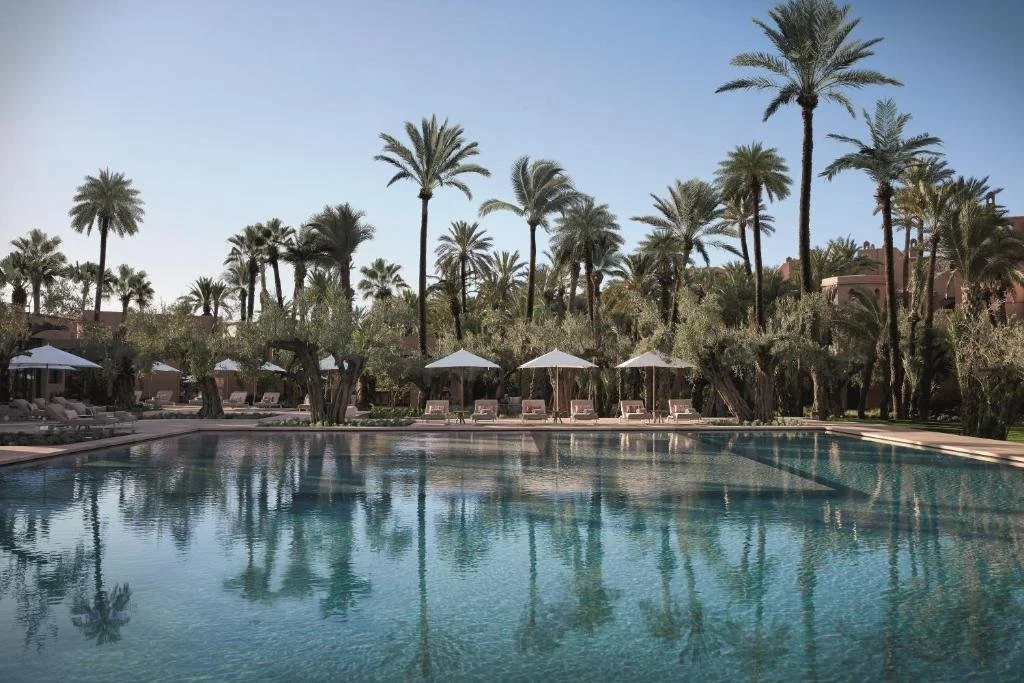
Royal Mansour — Marrakech
Commissioned by King Mohammed VI and finished in 2010, and there is nothing else like it anywhere. You don't get a room. You get your own three-storey riad with a private courtyard, a plunge pool, and a rooftop terrace, inside a walled medina built specifically for the hotel.
The detail everyone repeats is true. There is a network of tunnels beneath the property so that staff enter your riad from below and you never see anyone arrive or leave. Fifty-three riads, a spa in a white wrought-iron atrium that looks like a birdcage, and craftsmanship that took 1,200 Moroccan artisans three years.
The honest caveat: it is extraordinarily expensive, and the level of formality means it can feel more like being a guest of the state than staying in a hotel. Some people find the invisible service unsettling rather than seamless. Also worth knowing that for all the medina styling, you are in the Hivernage district rather than the real medina, so the atmosphere outside is modern Marrakech.
Best for: Once-in-a-lifetime trips, anniversaries, anyone who wants to see the top of what hospitality can do.
Check rates and availability at Royal Mansour →
Dar Ahlam — Skoura
The dreamiest hotel in Morocco, and the one we would book first. Dar Ahlam means house of dreams and the name is not marketing.
It is a nineteenth-century kasbah in a palm grove near Skoura, on the road between the Atlas and the desert, restored with about a dozen rooms. There is no reception, no menu, and no schedule. Someone asks what you feel like, and then dinner appears somewhere: in the garden, on a roof, in a candlelit corner of the kasbah, in the desert. It is different every night and you don't know where until you're taken there.
The whole operation is built around removing decisions from you, which sounds like a gimmick until you've spent three days there.
The honest caveat: it's remote, roughly four hours from Marrakech over the Tichka pass, and you go for the hotel rather than for anything nearby. Rates are all-inclusive and high, and the lack of choice genuinely bothers a certain kind of traveller. If you like reading a menu, this will irritate you.
Best for: Honeymoons, second trips to Morocco, anyone who wants to stop making decisions for a week.
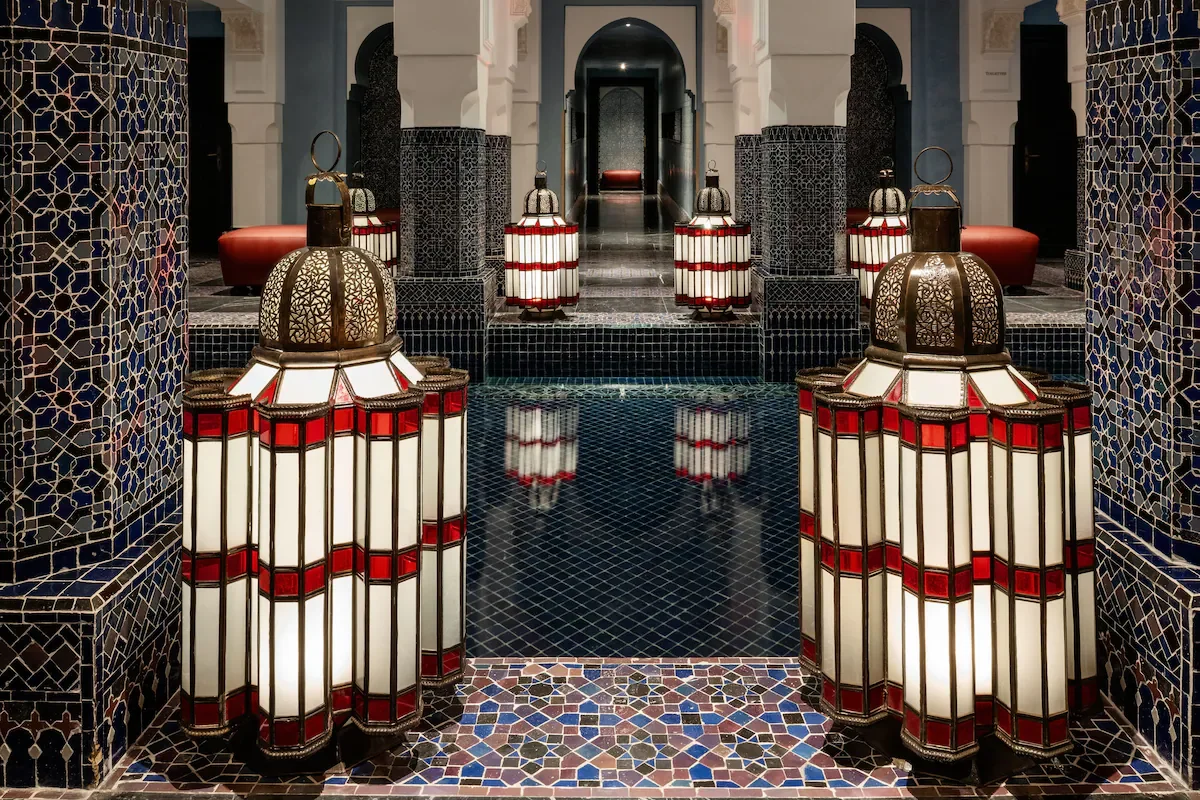
La Mamounia — Marrakech
The icon. Open since 1923, twenty acres of walled gardens that predate the hotel by two hundred years, and a guest list running from Churchill, who painted here and called it the loveliest spot in the world, through most of the twentieth century.
The Jacques Garcia redesign gave it a heavier, more theatrical look than the original Art Deco, and it works. The gardens are the real thing though: orange groves, olive trees, and roses, all inside the medina walls a short walk from the Koutoubia.
The honest caveat: it is large, at around 200 rooms, and in high season it feels it. The spa and pool areas get busy, and the sense of grandeur comes with a certain amount of tour-group energy in the public spaces. Standard rooms are also noticeably less special than the suites, so if you're booking at entry level, calibrate.
Best for: First trips to Marrakech, people who want the historic name, garden lovers.
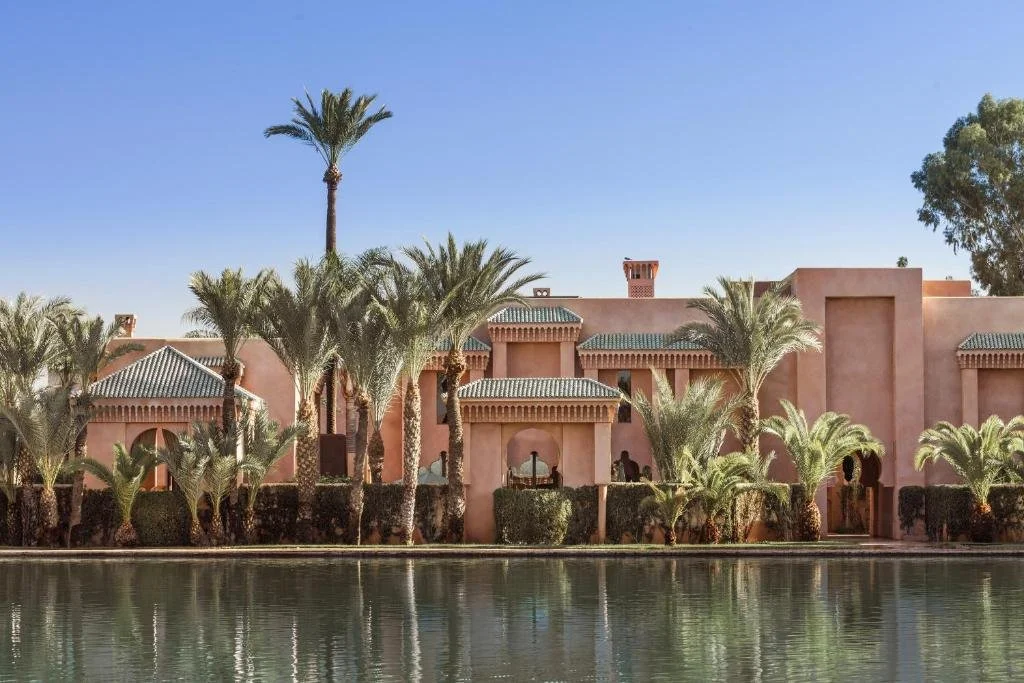
Amanjena — Marrakech
Aman's Moroccan property, about fifteen minutes outside the city, and the calmest place on this list. Pink pisé walls, a huge central basin pool that references the ancient irrigation reservoirs, olive groves, and the Atlas on the horizon.
Pavilions rather than rooms, each with a domed ceiling and a private courtyard. It's the most architecturally serious hotel in Morocco and the quietest.
The honest caveat: you are outside the city and you will drive in and out, roughly twenty minutes each way. That's fine for a few days of doing very little and frustrating if you want to be in and out of the medina constantly. Aman's restraint also means less Moroccan character than a riad, which is either the appeal or the problem.
Best for: Couples, people who have done Marrakech before, anyone who wants space and silence.
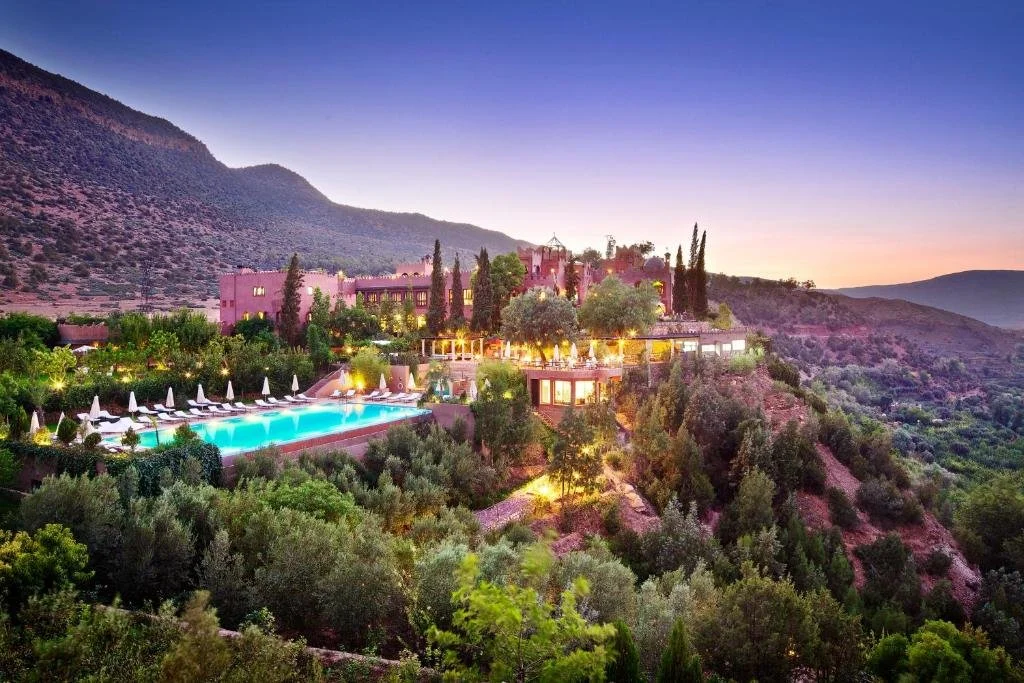
Kasbah Tamadot — Atlas Mountains
Richard Branson's place in the Atlas above Asni, about an hour from Marrakech, and the best reason to leave the city for a night or two.
It's a kasbah on a ridge with the mountains directly in front of it, plus a set of Berber tents with private pools further up the slope. The tents are the thing to book. Waking up at that altitude with the High Atlas across the valley is the single best view of any hotel in Morocco.
Walking from here is excellent, and Toubkal, the highest peak in North Africa, is close.
The honest caveat: an hour of mountain road each way, and it gets genuinely cold at night from November through March. The tents are heated but they are still tents. Also more of a resort than a retreat, with a lot of activity programming, which some guests want and others don't.
Best for: Combining with Marrakech, walkers, families who want the mountains.
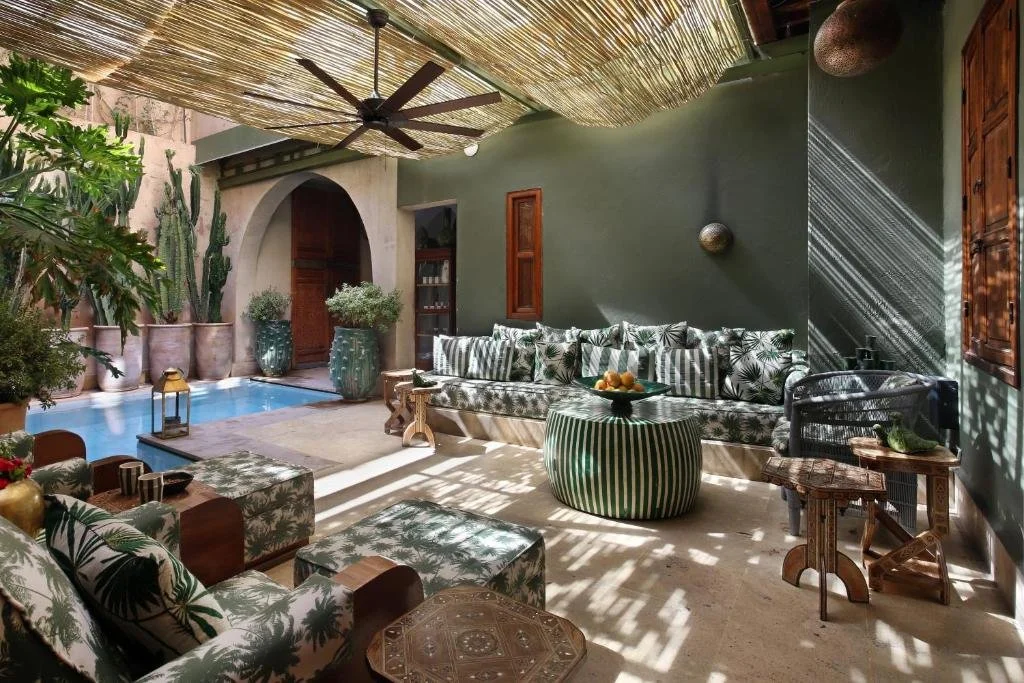
El Fenn — Marrakech Medina
The design riad, owned by Vanessa Branson, and the one that changed what a Marrakech riad could look like. Twenty-odd rooms across several connected houses in the medina, filled with a serious contemporary art collection, all colour and texture and courtyards opening into other courtyards.
The rooftop is the best in the medina, with a bar, a pool, and the Koutoubia and the Atlas beyond it.
The honest caveat: it is in the medina, so you walk in with your bags and the surrounding streets are loud, busy, and occasionally overwhelming. Rooms vary a lot and some are considerably better than others. The art, which is genuinely good, is also not to everyone's taste.
Best for: Design-led travellers, first trips where you want to be inside the medina, anyone who'd rather stay somewhere with a point of view.
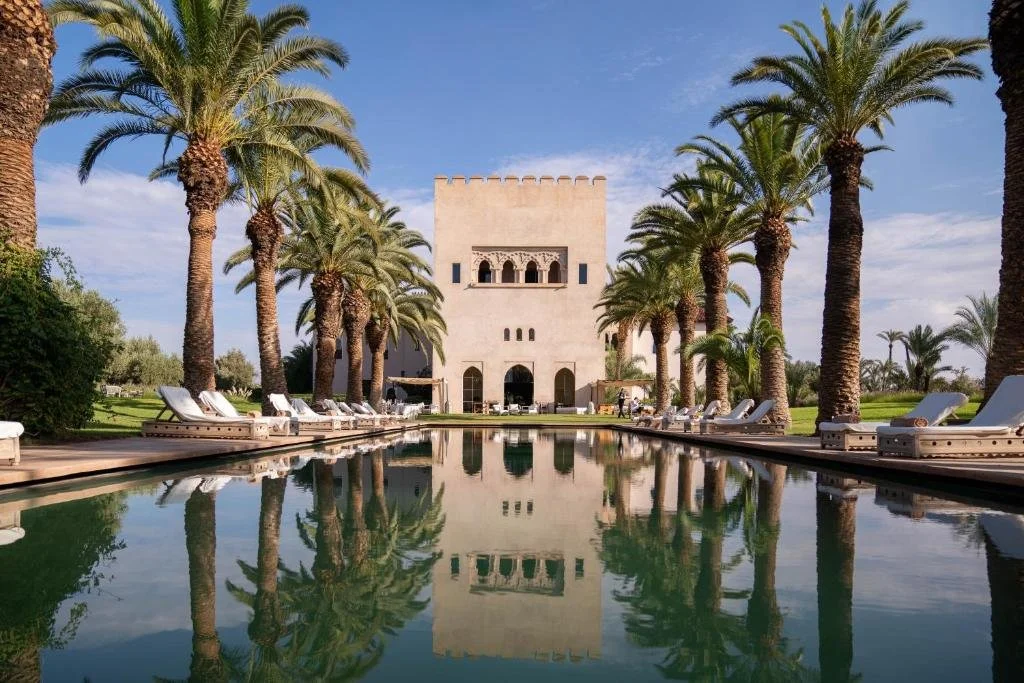
Ksar Char-Bagh — Palmeraie
A Moorish palace built from scratch in the Palmeraie, modelled on fourteenth-century Alhambra architecture, with a dozen or so suites, a library of several thousand books, and gardens laid out on the Persian four-part plan the name refers to.
Relais & Châteaux, family-run, and quieter than anything in the city. It is the least famous property on this list and one of the loveliest.
The honest caveat: the Palmeraie is a twenty-minute drive from the medina and it is a dispersed area rather than a neighbourhood, so there is nowhere to walk to. The scale is small and the facilities modest compared with the palace hotels.
Best for: Couples, repeat visitors, people who like a hotel with a library.
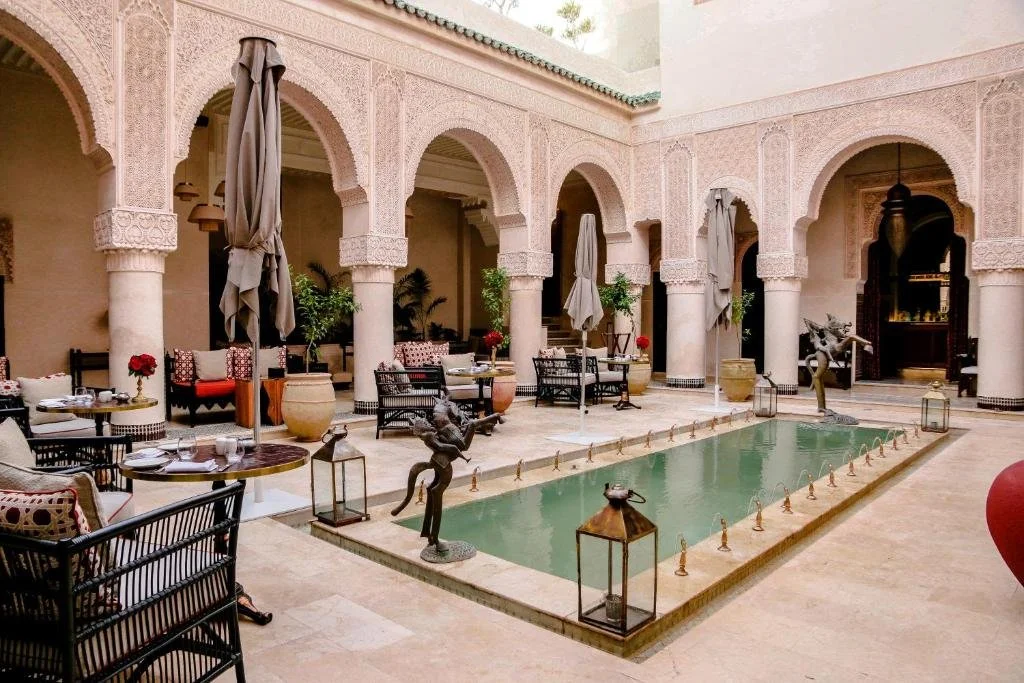
Riad Fes — Fes
Fes has the largest and best-preserved medieval medina in the world and almost nobody stays long enough. Riad Fes is a Relais & Châteaux property inside it, across several restored houses, with an Andalusian courtyard, a black-tiled pool, and a rooftop looking across nine thousand alleys of the old city.
Fes is harder work than Marrakech, less polished, and considerably more atmospheric. Two nights here changes what you think about Morocco.
The honest caveat: the Fes medina is genuinely disorienting, pedestrian-only, and can be intense. Getting to the riad involves a walk, and getting anywhere from it involves a guide, at least on the first day. The city has far less nightlife and dining than Marrakech.
Best for: Second trips, history and architecture, travellers who want the real thing over the comfortable one.
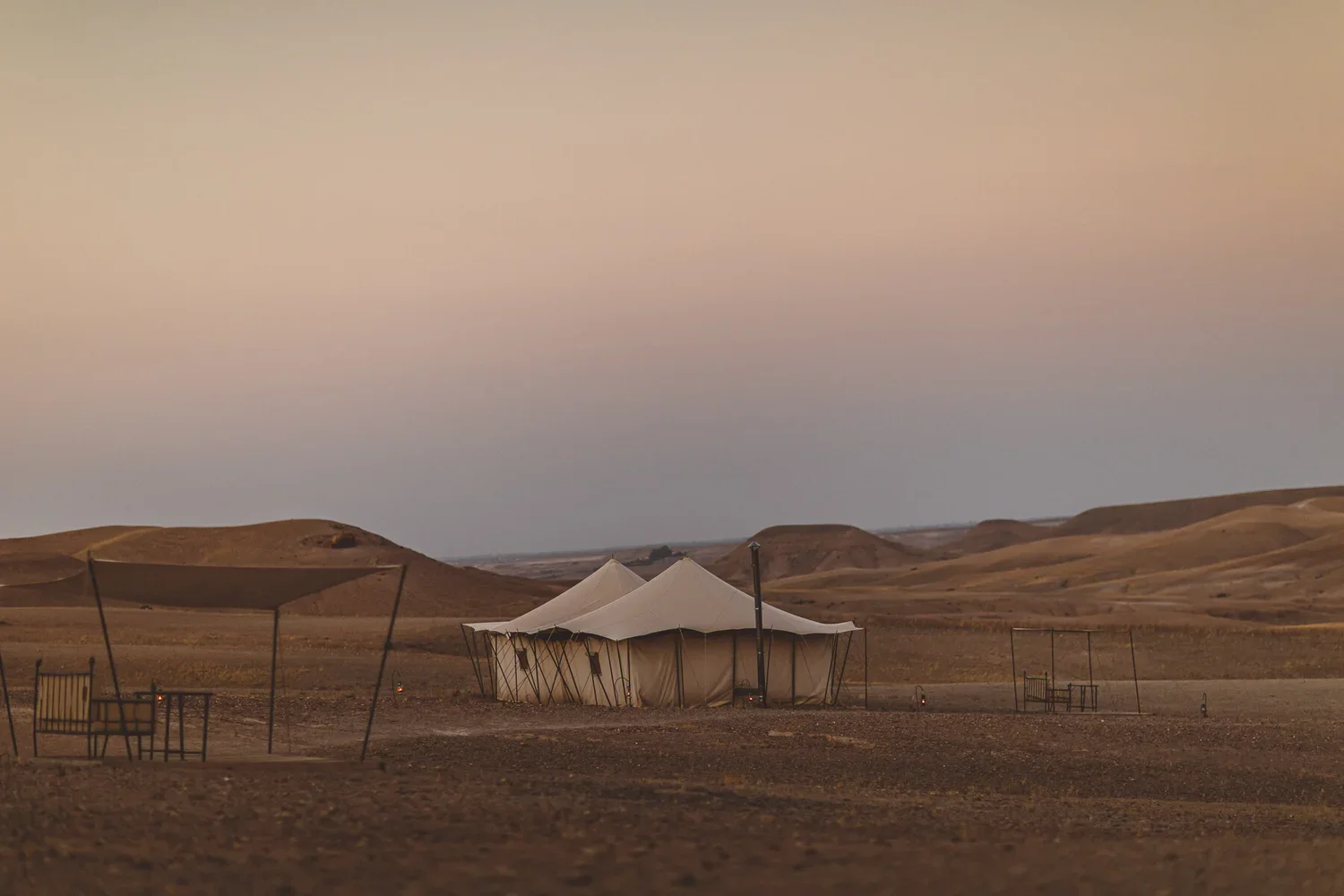
Scarabeo Camp — Agafay Desert
The Agafay is a stone desert about forty minutes from Marrakech, and Scarabeo is a tented camp in it, all canvas, kilims, and campaign furniture, with the Atlas along the horizon and nothing else in any direction.
It looks like the Sahara and is a fraction of the effort to reach. Dinner is under the stars and there is no light pollution at all.
The honest caveat: it is not the Sahara. There are no dunes here, it's rocky and lunar rather than sandy, and anyone who has seen the real thing will know the difference immediately. It's also basic by design: shared bathroom arrangements at some camps, no air conditioning, and cold at night in winter. One night, not three.
Best for: Adding a desert night to a short Marrakech trip, families, stargazing.
Check rates and availability at Scarabeo Camp →
Erg Chigaga Luxury Desert Camp — Sahara
The real thing. Erg Chigaga is the largest dune field in Morocco and the least visited, reached by a long drive south to Zagora and then several hours of off-road across the hamada.
The camp is properly comfortable, with rugs, beds, en-suite tents, and dinner around a fire, and the dunes go for fifty kilometres in every direction. Silence in a place like this is a physical thing.
The honest caveat: getting here takes a full day from Marrakech, sometimes two, and the last stretch is a rough 4x4 drive that is genuinely uncomfortable. It is not doable as a quick add-on. Merzouga is easier to reach and much busier, which is the trade.
Best for: Longer trips, second visits, anyone who wants the Sahara rather than the idea of it.
Check rates and availability at Erg Chigaga →
How to put a trip together
Most people over-schedule Morocco and end up spending the week in a car.
Four or five nights: Marrakech only, with one night in the Agafay. Enough for the medina, the Majorelle garden, the souks, and a day in the Atlas foothills.
A week: Marrakech, two nights at Kasbah Tamadot or in the Atlas, and back. Or Marrakech and Fes with the train between them, which takes about seven hours and is far more pleasant than driving.
Ten days or more: the southern loop. Marrakech over the Tichka pass to Skoura, on to the Draa valley and Erg Chigaga, and back. This is the trip Morocco is really for.
Our wider Africa coverage has more, including our guide to family safari hotels in Africa if you're combining Morocco with a safari further south.
BEST TIME TO VISIT AND BOOK
March through May is the best window. Warm rather than hot, the Atlas still snow-capped, and everything green after the winter rains. April is the single best month.
September through November is the other one. October in particular is close to perfect, with the heat gone and the light at its best.
June through August is brutal. Marrakech regularly passes 40°C and the desert is genuinely dangerous in the middle of the day. Rates drop for a reason. If you go, you'll be at the pool from eleven until five, and the desert is off the table entirely.
December through February is cold at night, particularly in the Atlas and the desert where it drops below freezing, and pleasant by day in Marrakech. It's the cheapest time and the medina is at its quietest. Bring layers, and note that many riads have limited heating.
One thing to check before booking: Ramadan moves each year and affects restaurant hours, some closures, and the general rhythm of the country. It's a fascinating time to visit and a difficult one if you haven't planned for it.
On cost: this is the best-value luxury destination we cover. Riads and boutique properties run €200 to €700, the palace hotels €600 to €1,500, and Royal Mansour well above that. A room that would cost €2,000 a night in Italy costs €600 here for equivalent quality and often better craftsmanship.
On booking: April and October need three to four months at the well-known properties. Royal Mansour, Dar Ahlam, and Amanjena all have limited rooms and go earlier. Summer and winter can usually be booked inside a month.
FAQ
What is the best hotel in Morocco? Royal Mansour in Marrakech, for sheer extravagance and craftsmanship. Dar Ahlam near Skoura if you want the most memorable stay rather than the most impressive one. La Mamounia if you want the historic icon.
Should I stay in a riad or a hotel in Marrakech? A riad for atmosphere and to be inside the medina, accepting that you'll walk in with your luggage and there's no proper pool. A palace hotel in Hivernage or the Palmeraie for gardens, a pool, and a car to your door.
How much do luxury hotels in Morocco cost? Roughly €200 to €700 for riads and boutique properties, €600 to €1,500 for palace hotels, and considerably more at Royal Mansour. Morocco is the best-value luxury destination in this part of the world.
When is the best time to visit Morocco? March through May and September through November. April and October are the two best months. Avoid June through August, when Marrakech passes 40°C.
Is the Agafay desert worth it, or should I go to the Sahara? The Agafay is forty minutes from Marrakech and looks the part but has no dunes. Erg Chigaga and Merzouga are the real Sahara and take a full day to reach. Do the Agafay on a short trip and the Sahara if you have ten days.
Can you drive to a riad in Marrakech? No. The medina streets are too narrow, so a porter meets you at the nearest vehicle access and you walk the last stretch. Factor that in if you have heavy luggage or mobility issues.
How many days do you need in Morocco? Four or five for Marrakech and a desert night. A week to add the Atlas or Fes. Ten days or more for the southern loop to the Sahara.
Is Morocco good for families? Yes, and Kasbah Tamadot and the palace hotels handle children well. Riads are harder with young kids because of stairs, plunge pools, and the medina walk.