
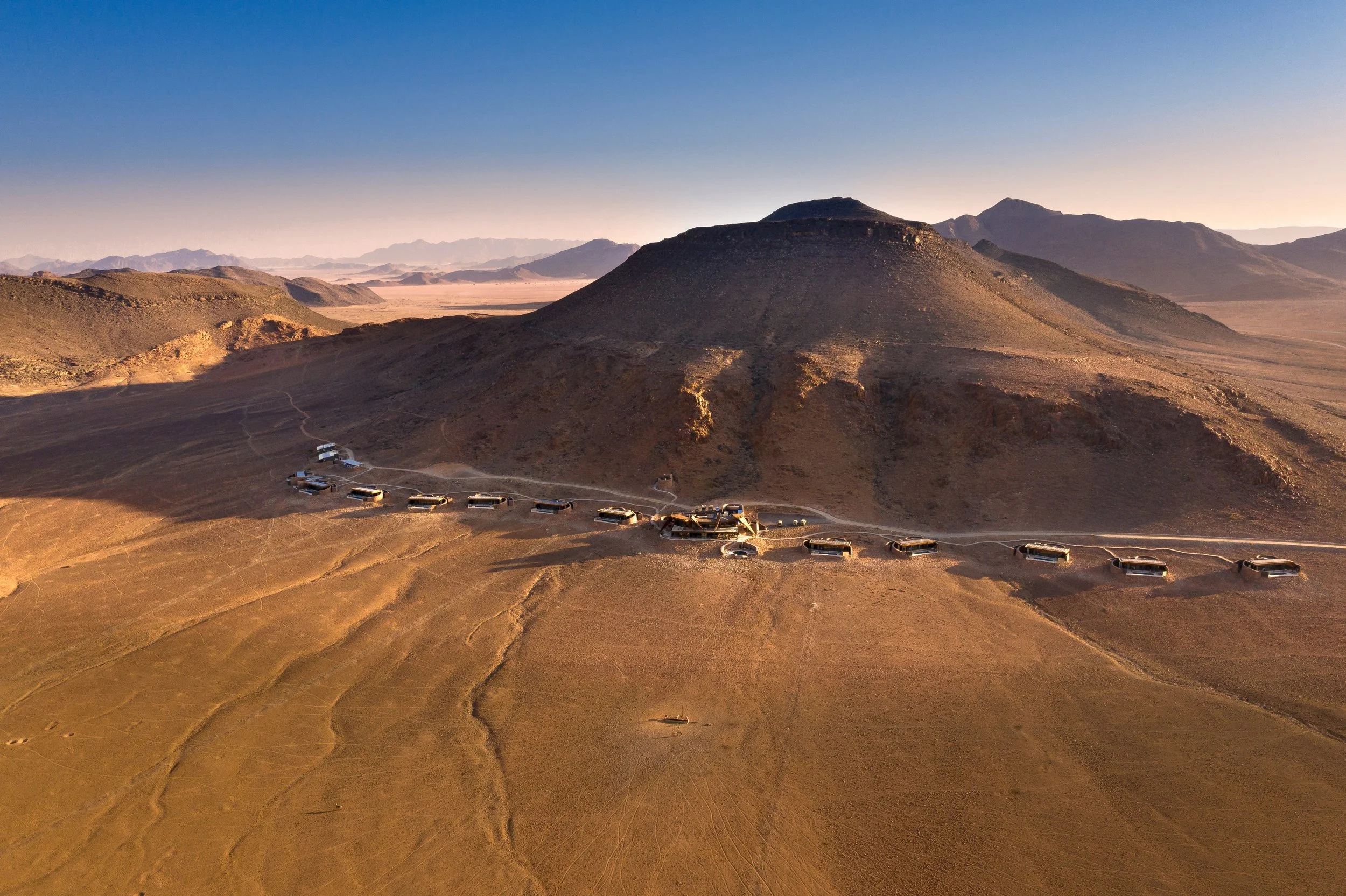
The verdict: Namibia's lodges cluster in four places and they do completely different jobs. For the dunes, andBeyond Sossusvlei Desert Lodge and Little Kulala are the benchmarks, one for design and stargazing, the other for access. For actual wildlife, Onguma The Fort or Andersson's at Ongava on Etosha's edge. For black rhino tracking, Desert Rhino Camp in Damaraland. For sheer remoteness, Serra Cafema on the Kunene or Shipwreck Lodge on the Skeleton Coast. Most of these run $700 to $2,000 per person per night, with the most exclusive villas past $2,500. A ten- to fourteen-night fly-in circuit across two or three regions starts around $11,000 per person. Self-drive through the south and centre costs considerably less and works well.
The thing to sort out first
Namibia isn't a destination you pick a hotel in. It's a destination you pick a route through, and the lodges follow. Four regions carry almost all the good accommodation. Sossusvlei and the NamibRand in the centre-south, for the dunes. Damaraland and Kaokoland in the northwest, for rock, desert-adapted wildlife and black rhino. The edge of Etosha in the north, for conventional game viewing. The Skeleton Coast, for isolation and strangeness.
A classic route links Sossusvlei, Swakopmund or the Skeleton Coast, Damaraland and Etosha over eight to twelve days.
Self-drive or fly-in is the second decision, and it's mostly geography. The south and centre, Sossusvlei, Swakopmund, and the Etosha area, have good roads and are genuinely enjoyable to drive. If your route reaches into remote Damaraland, Kaokoland or the Skeleton Coast, light aircraft stops being a luxury and becomes the rational choice. Both work. They're just different trips and very different budgets.
If you're bringing children, read this first
Namibian lodges ration by age, and the policies are specific. Ongava's are typical and worth quoting as a shape: children from six are accommodated and join activities, six to sixteen must share a room with an adult, twelve and under must be booked onto a private vehicle, and the minimum age for walking activities is thirteen. A lodge saying children are welcome is not the same as a lodge where your child can go on the drive, and the private-vehicle requirement is a real cost, not a formality.
The upside is that Namibia is one of the more workable African family destinations, because the desert half of the trip isn't age-gated in the same way. Climbing a dune has no minimum age. Our Africa hub works through the age question across the continent, and the best safari hotels for every age can found here.
Sossusvlei and the NamibRand
andBeyond Sossusvlei Desert Lodge
The design benchmark, and the one to book if the sky is the point. It sits in the Namib Sand Sea as a structure of glass, rock and steel, and each suite has a skylight above the bed. There's an on-site observatory with a resident astronomer, in what is a certified Dark Sky Reserve.
Namibian winter skies are among the best anywhere on earth, and this is the property built around that fact rather than mentioning it in a brochure.
Little Kulala
The stylish first-timer's choice, and the one with the access. It's a Wilderness property with exclusive access toward Sossusvlei and Deadvlei, which means reaching the dunes before the day visitors arrive — the single most valuable thing a Sossusvlei lodge can offer.
Dining goes beyond the usual with dry riverbed lunches and wine-cellar dinners, and activities run from nature drives and stargazing to quad biking and e-biking. Kulala Desert Lodge is the more accessible sibling on the same reserve, for the same early access at a lower rate.
Book it for: a first Namibia trip where you want the dunes at sunrise without a convoy.
Kwessi Dunes
In the northern NamibRand, with star-beds for sleeping out under the sky and a more grounded, classic safari feel than the design properties.
Worth knowing: it's a good hour from the Sesriem gate, so it offers the Sossusvlei excursion on stays of three nights or more. If Sossusvlei is your priority and you're only staying two nights, book closer.
Wolwedans Dunes Lodge
The NamibRand original, on a private reserve rather than at the park gate. Quieter and more conservation-led than the Sesriem cluster, and a genuinely different landscape.
Damaraland and Kaokoland
Desert Rhino Camp
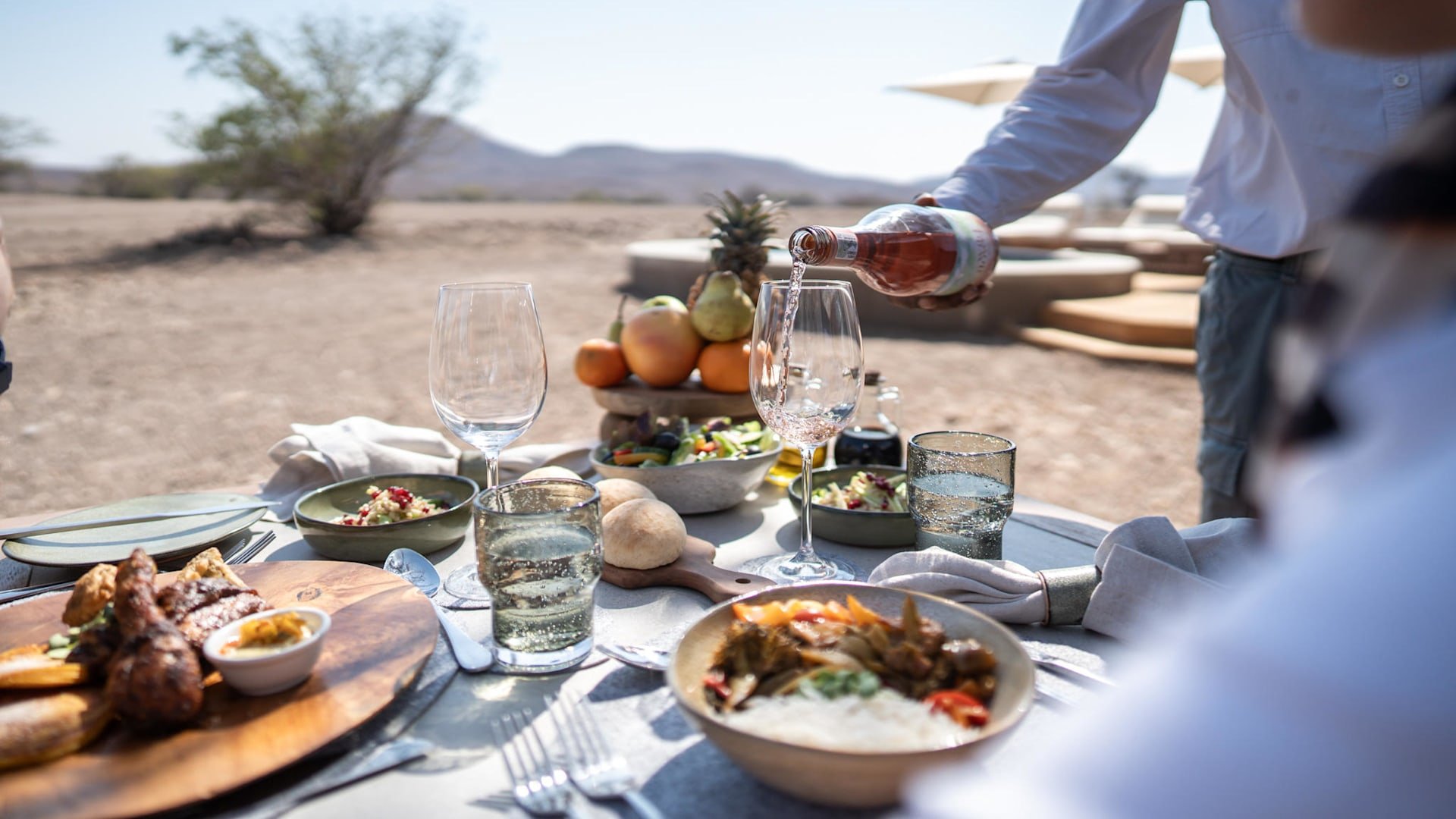
The reason to come to Damaraland. It runs black rhino tracking on foot in partnership with Save the Rhino Trust, and it's one of the few places on earth you can do it. Note the walking-age minimums, which will rule it out for younger children.
Damaraland Camp
The conservation-minded choice, and one of the longest-running community joint ventures in the country. A good balance of comfort, landscape and purpose without the rates of the remote camps.
Doro Nawas
The classic Damaraland stay: open plains, ancient mountains, rooms with rooftop sleep-outs, and desert-adapted elephant in the riverbeds when the timing is right.
Mowani Mountain Camp
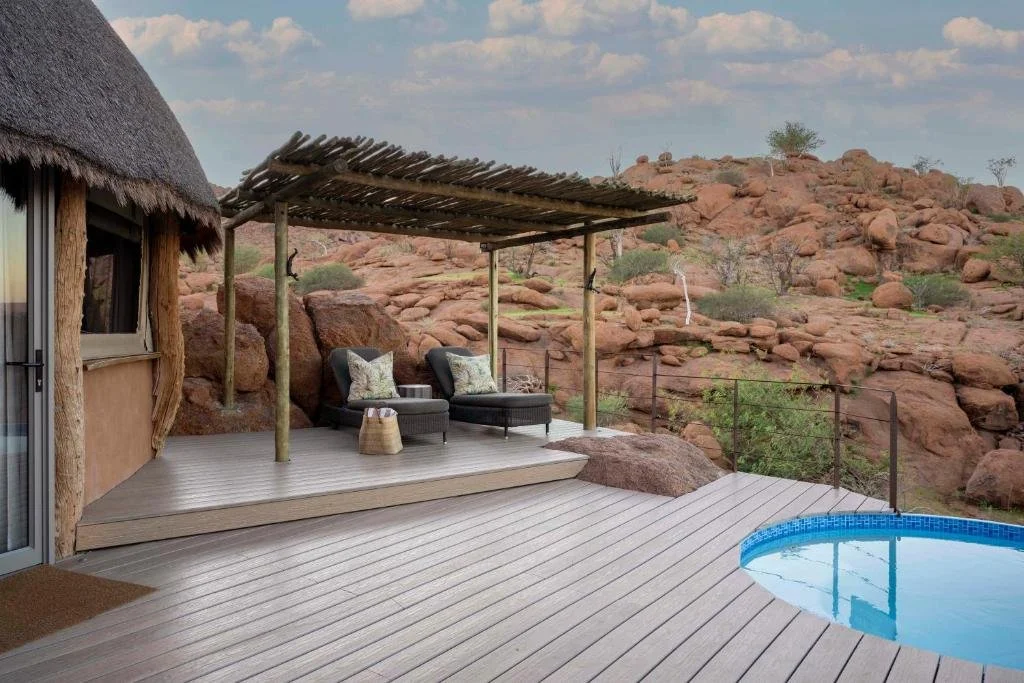
The romantic one, overlooking the rocky mountains of Damaraland close to the Twyfelfontein rock engravings. Suites are split into view and non-view tents, though the views are good throughout and the real difference is elevation. The Luxury Suite has its own pool and sits closer to the main area, which matters if rocky paths are a problem.
Hoanib Skeleton Coast Camp
Wilderness's remote camp on the transient Hoanib River, with just eight twin-bedded tents including one family unit. Desert-adapted lion, elephant and giraffe, in a landscape that reads as genuinely otherworldly.
Serra Cafema
The most remote luxury camp in Namibia and arguably in Africa. Eight thatched bungalows on the banks of the Kunene River under verdant trees, with rapids audible from camp, which, in the middle of the Namib, is a surreal thing to fall asleep to.
It sits in the home area of the Himba, Namibia's last semi-nomads, and the cultural visits are handled as a considered part of the stay rather than an add-on. Quad biking through the Hartmann Valley is the signature activity. Wildlife is desert-adapted oryx and zebra, crocodiles in the river, and desert chameleons.
Roughly $1,200 to $1,800 per person per night. Light aircraft only.
Book it for: the single most remote stay on this page. Skip it if: you want game density, which this isn't about.
The edge of Etosha
Onguma The Fort
The photographer's pick. It overlooks Fischer's Pan with sunsets that justify the whole trip, on a private reserve bordering Etosha.
Andersson's at Ongava
The conservation-led choice and, for our money, the better Ongava property. Strong suites, proximity to Etosha National Park, and a genuine research and conservation programme attached rather than bolted on.
Ongava Lodge
Twenty suites on the Ongava private reserve, with a waterhole you can watch from your terrace, game drives that reliably produce elephant, lion, leopard, rhino and giraffe, and night drives for nocturnal species. Roughly $600 to $800 per person per night, which makes it the value pick in this section.
Little Ongava and Horizon by Ongava
The top of the Namibian market. Little Ongava has three suites on a ridge above the reserve and is routinely described as the most expensive lodge in the country. Horizon by Ongava is the three-villa property with private infinity pools, and published 2026 rates start from NAD 50,800 per person sharing per night, excluding the conservation fee — which puts it above $3,000 per person per night.
The honest caveat: some activities are shared across the Ongava properties, so you are partly paying for the suite rather than for an entirely separate experience. With three villas it books far ahead, and taking all three as an exclusive-use property is how it makes most sense.
The Skeleton Coast
Shipwreck Lodge
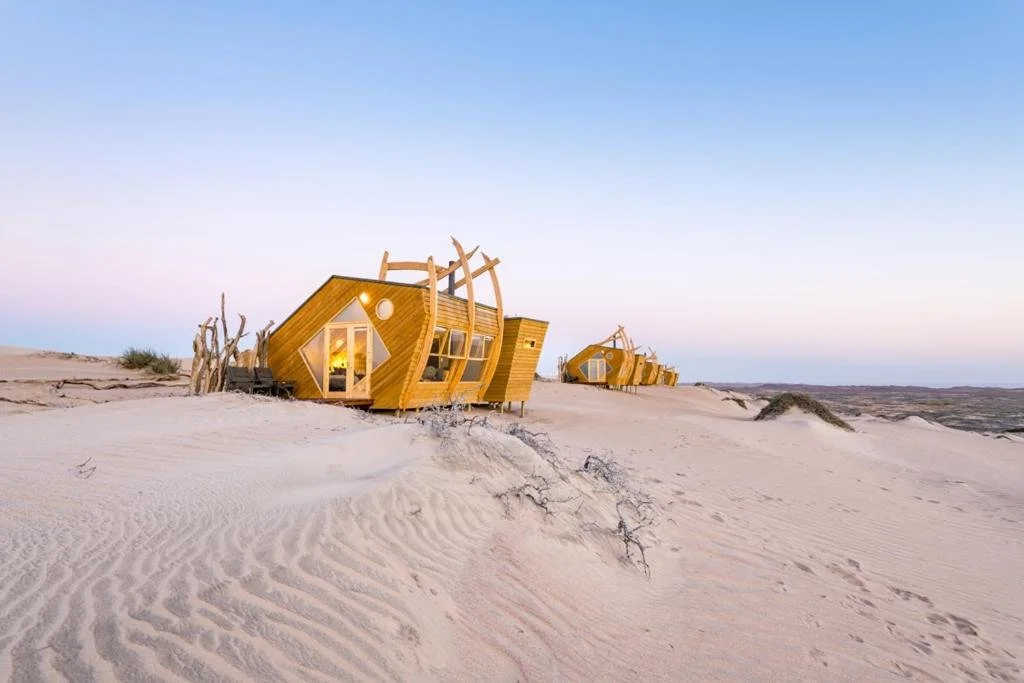
The one everyone photographs, and the strangeness is the point. Cold fog rolls in off the Benguela Current most mornings and the Atlantic throws a chill across the dunes that feels nothing like the rest of the country. The shore is scattered with whale bones and rusted hulls, and the lodge leans into it with cabins shaped like wrecks half-buried in the sand.
This is not a beach destination. The ocean is too cold to swim and that isn't a failing, it's the character.
Windhoek and the south
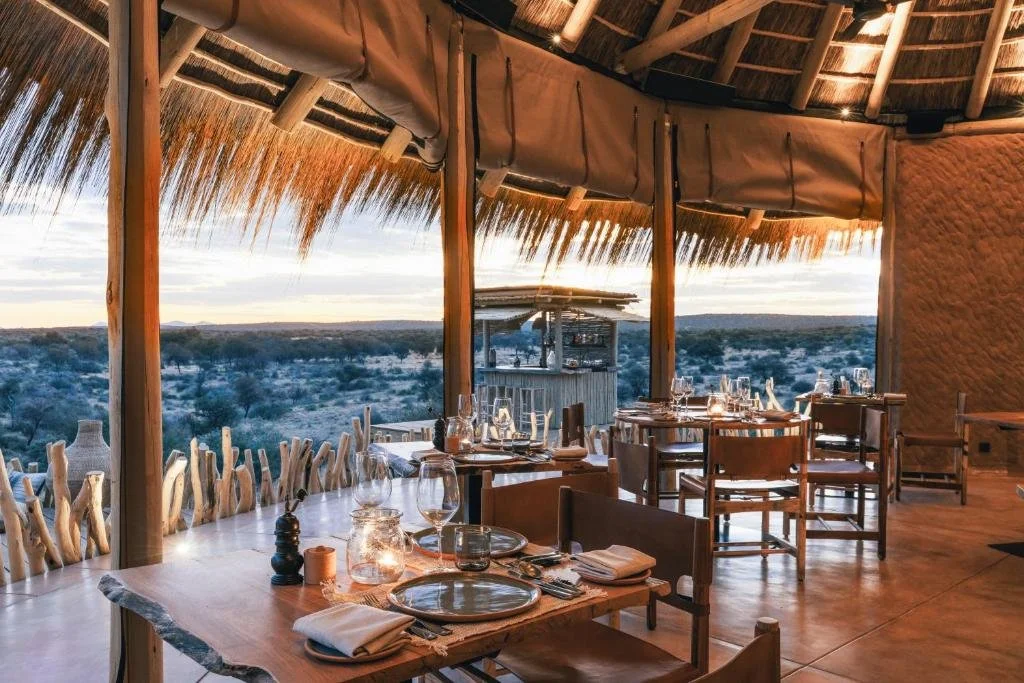
Zannier Omaanda
The arrival and departure lodge. A five-star property on a 9,000-hectare private reserve in the countryside outside Windhoek, with round thatched huts in traditional architecture, a heated infinity pool, a spa with two treatment rooms, a gym and a boma. Game drives on the reserve.
It solves the real problem of the Windhoek night at either end of a trip, which is otherwise a business hotel.
Zannier Sonop
The other Zannier, in the south, and the most stylistically committed property in Namibia. It's done as a 1920s explorer's camp — ten tents on a granite outcrop, antiques, billiards, a vintage register — and horseback safaris across the desert are the signature. Roughly $1,200 to $1,700 per person per night.
The two Zanniers run a combined offer of 10 per cent off room rates for a minimum of three consecutive nights at Sonop and two at Omaanda within fourteen days. Worth checking whether it's still running when you book.
What it costs
Namibian lodges quote per person per night, all-inclusive, which catches people out. A family of four for five nights is a serious number before you've bought a flight.
Value end, Etosha reserves: around $600 to $800 per person per night
Most good desert and Etosha-edge lodges: roughly $700 to $2,000
Remote camps like Serra Cafema and the Zanniers: $1,200 to $1,800
The exclusive villas: $2,500 and up, past $3,000 at Horizon by Ongava
A fly-in circuit across two or three regions, ten to fourteen nights: from around $11,000 per person
Rates generally include meals, twice-daily activities, park fees, laundry, VAT, tourism and conservation levies, and local drinks. Premium imported spirits and champagne are usually excluded, as are light aircraft transfers, which add meaningfully.
Self-drive through the south and centre costs a fraction of the fly-in figure and is a genuinely good way to see Namibia.
How to choose
If it's your first trip, Sossusvlei and Etosha, self-driving. Little Kulala or Kulala Desert Lodge, then Ongava or Onguma.
If the dunes are the reason, andBeyond Sossusvlei Desert Lodge for the design and the observatory, Little Kulala for the early access.
If you want wildlife, the Etosha edge. Andersson's at Ongava for the conservation programme, Onguma The Fort for the photography.
If you want to track black rhino on foot, Desert Rhino Camp, and check the walking age minimum first.
If you want to be genuinely far from everything, Serra Cafema or Shipwreck Lodge.
If you're travelling with children, the desert half is the easy half. Sossusvlei has no age gates on dune climbing, and Swakopmund's sandboarding and quad biking work well. Sort out the game-lodge age policy and the private-vehicle requirement before you fall in love with a photograph.
If you have a week rather than two, do Sossusvlei and Swakopmund and skip the north. A week doesn't do Namibia justice, and trying to add Etosha and Damaraland means spending it in a vehicle.
Best time to visit Namibia
May through October is the dry season, and it's the reason to come. The bush thins out, animals concentrate around water, and the skies are clear.
June through August is the sweet spot for the desert specifically. Days run 20 to 25°C with effectively no rain, and the cool weather is exactly what you want for climbing dunes when the sand isn't searingly hot. Nights are genuinely cold, often below 10°C and sometimes below freezing in the desert and at altitude, so pack layers you'd take to a mountain.
On the coast, expect stiff wind and thick morning fog through winter, which generally burns off before midday.
November through April is the green season: cheaper, greener, more dramatic skies, and harder for spotting.
Book early for June to September. Namibia's best lodges are small, several have three to eight rooms, and the country is vast enough that there's no fallback down the road.
FAQ
What is the best hotel in Namibia? There isn't one, because the regions do different jobs. andBeyond Sossusvlei Desert Lodge and Little Kulala are the benchmarks for the dunes, Andersson's at Ongava for wildlife, Desert Rhino Camp for rhino tracking, and Serra Cafema or Shipwreck Lodge for remoteness.
How much do lodges in Namibia cost? Most good lodges run $700 to $2,000 per person per night, all-inclusive. The value end around Etosha is $600 to $800, and the exclusive villas run past $3,000. A ten- to fourteen-night fly-in circuit starts around $11,000 per person.
Should I self-drive or fly? Self-drive the south and centre, which has good roads and is genuinely enjoyable. Fly if your route reaches remote Damaraland, Kaokoland or the Skeleton Coast, where light aircraft is the only sensible option.
Is Namibia good for children? The desert half is excellent and mostly free of age restrictions. The game lodges are not: many cap standard drives at six, several require a private vehicle for twelve and under, and walking safaris generally start at thirteen. Check the specific lodge policy before booking.
When is the best time to visit Namibia? May to October for the dry season, and June to August specifically for the desert, when the dunes are climbable and the skies are clearest. Nights are cold.
How long do you need in Namibia? Eight to twelve days for a classic route linking Sossusvlei, the coast, Damaraland and Etosha. A week limits you to Sossusvlei and Swakopmund, which is a good trip but not the whole country.
What's included in a Namibian lodge rate? Typically meals, twice-daily activities, park fees, laundry, VAT and levies, and local drinks. Usually excluded: premium imported spirits, champagne, and light aircraft transfers.
Is the Skeleton Coast worth it? If isolation and strangeness are what you're after, yes. If you're expecting a beach, no. The water is too cold to swim and the fog is near-daily.